
Book Banning Then and Now
By M. Lynne Squires

In 1974, when I was in high school, a textbook controversy erupted in Kanawha, the largest county in West Virginia. A local minister and his followers objected to several of the textbooks that had been approved for student use. One of the preacher’s sycophants was on the county school board, and his daughter was my school mate. The protests began, the media latched onto the story, and in short order, bomb threats were a daily occurrence at many schools in the county.
My high school drew fire twice as often, perhaps because of the school board member’s daughter. With each bomb threat, some 2,000 students had to evacuate the building, while every locker and classroom were searched. Pictures from the yearbook show my classmates sitting outside with books and lunch trays on their laps. As cold weather approached, we huddled in the winter coats we carried from class to class, lest we end up once more out in the cold, sans coat. It was a miserable year.
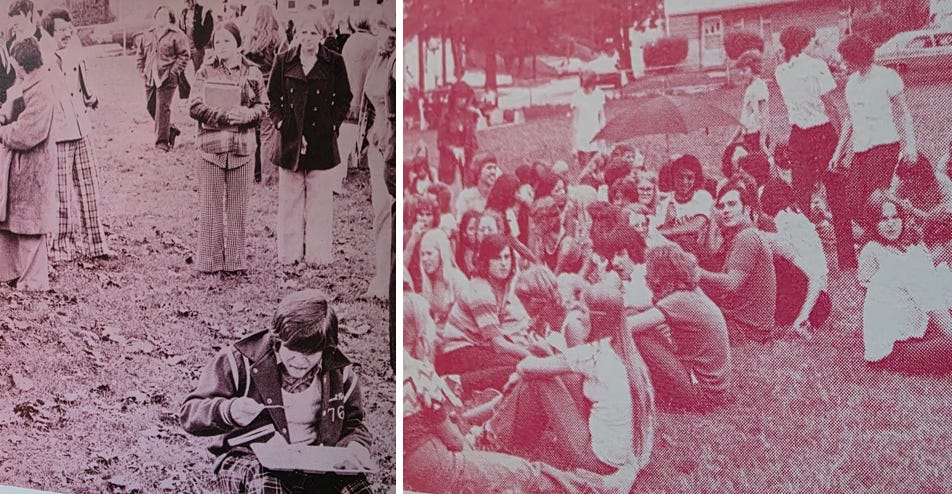
Fast forward to the present day when calls for book banning endure. Many of those same titles from my high school years remain on the targeted list. And once again a majority of folks protesting will admit they have not read the very books they profess to abhor.
Not only are certain situations and relationships deemed objectionable, but entire swaths of history are on the chopping block. Refences to climate change, along with Native American, Black, and LGBTQ+ histories are systemically being erased. But what can any of us do?
Several things, actually.
Be a friend to your local library. Visit, read, and engage. Donate money, time, and resources. Libraries are safe havens for both children and adults. Become familiar with and support their programs. Be an advocate of the very place where the books live and are accessible to all. Read the proposed banned books and be armed with facts about the book’s actual contents and context.
Ask local librarians what you can do to help. These community servants are primary defenders of intellectual freedom and the rights of the public to access diverse information. Removing books from library shelves because of ideological disagreements or with the goal of limiting access to specific viewpoints is generally unconstitutional.
Support authors. They are both advocates against and targets of book banning campaigns. Go beyond just buying books. Ask your library to add local authors’ books to their collections. Attend author events to learn about their books and meet other like-minded folks. Post book reviews on Amazon, Goodreads, and social media. Post on social media or email authors with your encouragement and support for their work.
Buy books. Any books. But most importantly, buy books coming under attack. Some of the challenged books comprise the literary foundation of this country. Simply reading a book does not automatically ensure the reader will adopt the opinion or premises within. Reading does, however, instill critical thinking skills necessary to make fully informed decisions.
Become an informed reader. The desire to control the educational environment with the goal of ensuring materials align with a particular standard stifles the basic right to free speech.
Perhaps most importantly, encourage reading. Where possible, volunteer to teach reading. Investigate the literacy statistics in your area. Overall, in the United States, approximately 21% of adults are functionally illiterate.
The truth often dies in darkness. Be the light for the words under attack.
Table Rocker M. Lynne Squires is an Urban Appalachian Author. She writes fiction, essays, and dabbles in poetry. Her first novel, River of Silence, is forthcoming in May from Mountain State Press.
~~~~~~~~~~~~~~~~~~~~~~~~~~~~
Table Rock Faculty:
Supporting Libraries
and the Freedom to Read
Here are messages recorded by veteran members of the Table Rock faculty. They are participating in a new social media campaign in support of North Carolina librarians, some of whom have been challenged for their choices in books offered and displayed in our state’s public libraries. Click on each image.
Thanks to M.Lynne Squires for sharing her vivid and timely story. And thanks to Judy, Joseph and Jill. Hearing their memories reminds me of my own first love of reading at the East Branch Library in Charlotte.
If you have a testimonial or story to support reading and libraries and want to participate in the campaign, just let me know by text or email.
I’ll send you more information.
Donna Campbell
919.656.7407
Dcminnow@gmail.com
It's beyond ironic that one of the books that led to Tennessee library director, Luanne James being fired was "Welcome to Your Period." The book was written for 10-14 year olds. One description, in part, reads, "this book has a reassuring, shame-free conversational tone that will appeal to preteens and teens. Topics include: the basics, getting ready for your first period, managing and tracking your cycle, period challenges, hygiene, puberty, and so on." Hardly a book that belongs in the adult section.